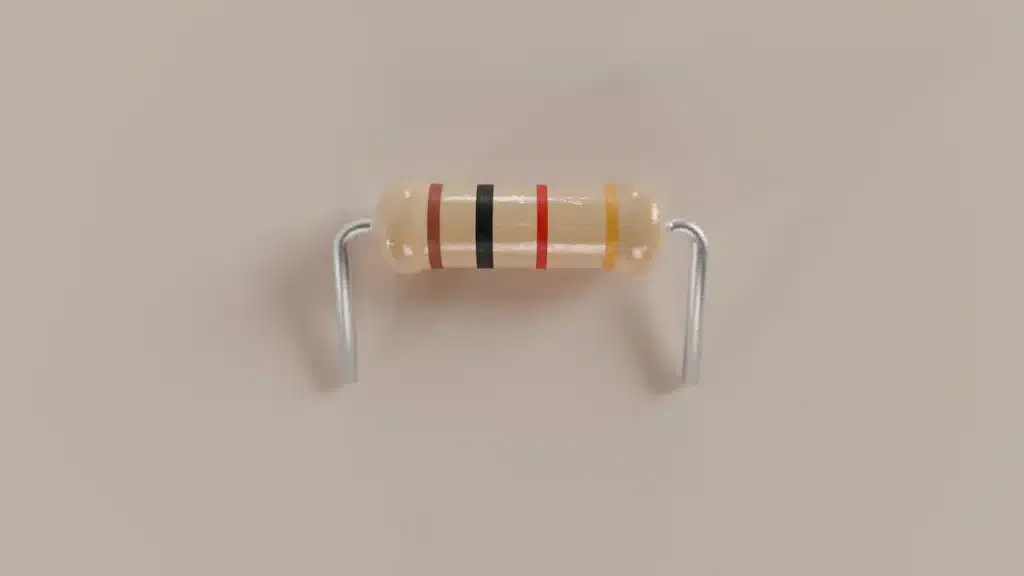

A resistor is a basic electronic part. It slows down electricity in a circuit. Knowing about resistors is key for electronics. This small part makes electrical resistance. It controls how electricity flows. These parts are very important. Their market will grow. It will reach $16.28 billion by 2035. It will grow by 3.91% each year.
Key Takeaways
A resistor is a basic electronic part. It controls electricity flow.
Ohm’s Law helps us understand resistors. It connects voltage, current, and resistance.
Resistors have many jobs. They limit current. They divide voltage. They adjust signal levels.
There are different types of resistors. Fixed resistors have one value. Variable resistors let you change it.
Resistors can connect in series. They can also connect in parallel. This changes how they work.
What is a Resistor?

You might ask, what is a resistor? It is a basic electrical part. It has two ends. Think of it like a gate. It is in an electrical path. It slows down electricity. It limits the flow of electric current. This happens in circuits. Imagine water in a pipe. You can make the pipe smaller. This slows the water. A resistor is like that small pipe. It controls electricity’s “flow.”
Defining Electrical Resistance
Electrical resistance is how much a material stops electricity. Every material resists electricity. This is why wires get warm. It happens when electricity flows. Resistance shows how much a material fights current. It decides how much current flows. This is when voltage is used. Some things change this resistance:
Length (L): Longer materials have more resistance. A longer path means more resistance.
Cross-sectional Area (A): Wider materials have less resistance. A wider path lets more electricity flow.
Type of Material (ρ): Different materials resist differently. This is a set number for each material.
Temperature: Resistance changes with heat. For most wires, resistance goes up. This happens when it gets hotter.
The Ohm: Unit of Resistance
The unit for electrical resistance is the ohm. We use the symbol (Ω). This unit honors Georg Simon Ohm. He was a German scientist. He was born in 1789. Ohm found a link. It was between voltage and current. This is now called Ohm’s Law.
Ohm’s Law says current in a wire. It goes up with voltage. It goes down with resistance. You can write it as V = I × R. V is voltage. I is current. R is resistance. This law helps us understand resistors. One ohm (Ω) is exact. It is the resistance between two points. This is when 1 volt makes 1 ampere flow. Ohm’s work helped us understand. It showed how voltage, current, and resistance connect. This helped engineers. They could design better circuits.
How Resistors Work
Impeding Electron Flow
Voltage makes electrons move. These tiny bits move fast. They go over 1 million meters per second. But they do not flow smoothly. They move in random ways. There is no overall flow. An electric field pushes them. They get a small ‘drift velocity’. This is a slow push. It is in one direction. For example, it might be 0.0001 meter per second.
Resistance happens when electrons bump. They hit ions. These ions are in the conductor. Imagine a crowded hall. You try to walk through it. You bump into people. This slows you down. An electron in copper hits an ion. It hits after passing about three hundred others.
Some things make more bumps. They also make bumps stronger:
Irregularities in the crystal lattice: The material has flaws. These flaws cause more bumps.
There are gaps. Or there are misalignments.
Impurity ions are mixed in. These ions are a different size.
Lattice ions vibrate. This is from heat.
Temperature: The material gets hotter. Ions vibrate more. This means more bumps. They are more violent. This raises the resistance.
Ohm’s Law Explained
You can learn how parts work. Use Ohm’s Law. This law shows how voltage, current, and resistance connect. It is a key rule in electronics.
Ohm’s Law is a simple math rule: E = I x R. This means voltage equals current times resistance. In units, volts = amps x ohms.
Quantity | Symbol | Unit (Abbreviation) | Role in Circuits |
|---|---|---|---|
Voltage | E | Volt (V) | Pressure for electron flow |
Current | I | Ampere, amp (A) | Speed of electron flow |
Resistance | R | Ohm (Ω) | Stops the flow |
Many think V=IR is Ohm’s Law. But V=IR defines resistance. Ohm’s Law says for some parts, like an ohmic resistor, resistance (R) stays the same. This means current changes with voltage.
Be careful with Ohm’s Law. Do not mix up voltage. Do not use voltage from one part. Do not use it for another part. For example, you have a 10-ohm resistor. Calculate current through it. Use the voltage across that resistor. Do not divide a 120V source. Do not divide it by 10 ohms. This is if the resistor is not directly connected.
Energy Dissipation as Heat
Current flows through a resistor. Something else happens. The resistor gets warm. This is from energy dissipation.
Resistance happens. Electrons bump into things. These are inelastic collisions.
The metal structure gets in the way. It stops electron flow.
Electrons hit the structure. They lose energy. This energy becomes kinetic energy. This is heat.
This heating is called Joule heating. This is why a resistor loses power.
Think of a circuit. It has a resistor and a battery. The battery does work. All that work turns into heat. This is in the resistor. This follows energy conservation. Resistors always lose power. They change electrical energy into heat. This is a physical process. It shows power is conserved. Charge moves through a resistor. It loses potential energy. This lost energy becomes heat. We call this ‘dissipation’.
Resistors have power ratings. These show how much heat they can handle. Common ratings are 1/4 W or 10 W. These depend on size. They depend on what it is made of. If a resistor gets too hot, it can melt. Or it can vaporize. This makes the resistor burn out. It becomes an open circuit. This often starts in hot spots.
Some parts can handle power surges. But check the maker’s data. Not all parts are the same. Film parts can vaporize. This is during power surges. This can happen even if the temperature is fine. Wire-wound parts handle heat better. Sometimes, a part is made to fail. This is like a fuse. It protects other parts.
What Does a Resistor Do? Key Functions
You may ask, what does a resistor do? It does many important jobs. It controls electricity.
Current Limiting
A main job is to limit current. Resistors have a set resistance. This follows Ohm’s Law. They lower voltage and current. This stops damage to parts. Resistors are the easiest way to limit current. For example, in LED lights, they stop too much current. Without them, the LED gets too hot. It could break. You put a resistor with an LED. This keeps the current safe.
Voltage Division
Resistors can also split voltage. A voltage divider makes a smaller voltage. This circuit uses two resistors. They are in a line. The input voltage splits. It divides between them. The voltage splits based on their resistance. You find the output voltage (Vout). It is across one resistor (R2). Use this formula:
Vout = Vin * (R2 / (R1 + R2))
Voltage dividers have many uses. They read sensors. They change signal levels. They also measure high voltages. This helps in ensuring proper voltage for parts.
Signal Level Adjustment
Resistors change signal levels. This is in audio players. It is also in sensor hookups. They control how much an amplifier boosts. For example, in buffer amps, resistors set the boost. This helps size sensor signals. It also stops noise in audio.
Biasing Active Elements
Biasing means adding a steady voltage. Or it means adding current. This sets up parts like transistors. A resistor helps add this bias. This makes the transistor work right. It helps it work in a certain range. This is key for clear sound. It stops bad sound.
Transmission Line Termination
Resistors also help with lines. This stops signal reflections. Reflections can mess up signals. This is true for fast data. You put a resistor at the line’s end. Its value matches the line. This takes in signal energy. It stops reflections. This helps protect against voltage spikes. It makes a clean signal.
Common Resistor Types
You will find many different types of resistors in circuits. Each type serves specific needs. Knowing these types helps you pick the right part. This is for your project.
Fixed Resistors
Fixed resistors are very common. They have a set resistance value. You cannot change this value. Carbon composition resistors use carbon powder. They also use a binder. Film resistors have a thin layer. These include carbon film and metal film. Wirewound resistors use a metal wire. It wraps around a core. Each type has special uses. For example, metal film resistors are very exact. Their resistance changes little with heat. Common carbon film resistors are less exact. They are often ±5% or ±10%. This chart shows typical tolerance values:

Color | Tolerance |
|---|---|
Brown | ±1% |
Red | ±2% |
Green | ±0.5% |
Blue | ±0.25% |
Violet | |
Gray | ±0.05% |
Gold | ±5% |
Silver | ±10% |
None | ±20% |
The 6th ring on a resistor shows its temperature coefficient. This is ppm/°C. Resistors with lower temperature coefficients are more steady. They work better in different temperatures. For very exact uses, metal film or foil resistors are best. They have very low temperature coefficients. Metal film resistors can be very exact. They can be as precise as ±0.1%.
Variable Resistors
Next, you have variable types of resistors. You can change their resistance value. Potentiometers and rheostats are two main kinds. A potentiometer has three connections. It works as a voltage divider. This lets you measure voltage. Or you can change voltage levels. You often use them in low-power circuits. A rheostat controls current. It changes its resistance. It usually handles more power. It has two connections. One is fixed. One moves. Here is a comparison:
Feature | Rheostat | Potentiometer |
|---|---|---|
Number of Terminals | 2 | 3 |
Primary Use | Controlling current | Adjusting voltage |
Circuit Connection | Series | Voltage divider (or variable resistor) |
Power Handling | High | Low to moderate |
Adjustment Type | Coarse | Fine/precise |
A rheostat mainly controls current flow. It normally works with a load. It varies resistance by moving a wiper. This is along a resistive part. This changes the length of the current path. Potentiometers are very useful. You find them in many devices. They control fan speeds. They adjust oven temperatures. You also use them for motor speed controllers. In audio gear, they are volume controls. Think of your headset. Or your home audio system. They feel smooth and easy to use. This makes users happier.
Specialized Resistors
Finally, you have specialized types of resistors. These resistors change their resistance. This is based on things around them.
Photoresistor (LDR): Its resistance changes with light. In total darkness, it has very high resistance. As light goes up, its resistance drops.
Thermistor: Its resistance depends on temperature. PTC thermistors increase resistance. This happens as temperature rises. NTC thermistors decrease resistance. This happens as temperature rises.
Varistor: Its resistance changes with voltage. It has high resistance at normal voltage. When a voltage surge happens, its resistance drops fast. This sends extra current away.
You use thermistors in refrigerators. And in air conditioners. They check and control temperatures. Photoresistors turn streetlights on at night. They turn them off in the morning. They also work in security systems.
Resistor Connections in Circuits
You can connect resistors in different ways. This changes how they work. This helps you design better electronics.
Series Resistor Circuits
Connect resistors end-to-end. The current flows through each one. It is a single path. Think of a chain. The current is the same. It has only one path. The output current goes into the next.
To find total resistance, just add them up. For R1, R2, and R3 in series: R_S = R1 + R2 + R3. The current passes through each. Each adds to the total opposition. If one part fails, the whole circuit stops. The single path breaks.
Parallel Resistor Circuits
Connect all starts together. Connect all ends together. This makes many paths for current.
In a parallel circuit, voltage is the same. It is the same across each resistor. It is the same as the power source. For example, three resistors in parallel. Connect them to a 12-volt battery. Each resistor gets 12 volts. A charge moves through the circuit. It only passes through one resistor. It uses full voltage on that path.
Parallel connections are flexible. If one resistor fails, others still work. This is better than series. You can connect devices. They have different current needs. They all get the same voltage.
You now know this part’s key job. It controls current. This happens in every circuit. This small part keeps your circuit steady. It also saves other parts. For example, parts can break from heat. Or they can disconnect. This shows their big job. Makers create over 1.2 trillion resistors. They make them each year. This shows how vital they are. They are simple. But they are key parts. They build almost all electronics.
FAQ
What is the main purpose of a resistor in a circuit?
You use a resistor. It limits electric current. It controls electricity. This protects other parts.
How does Ohm’s Law help you understand resistors?
Ohm’s Law links voltage, current, and resistance. It helps you find current. You need to know the voltage.
Why do resistors get hot when current flows through them?
Resistors get hot. They lose energy. Electrons hit atoms. This makes heat. It is called Joule heating.
Can you change the resistance value of all resistors?
No, you cannot change all resistors. Fixed resistors have one value. Variable resistors let you change it.
See Also
The Crucial Role of Inverter Circuits in Modern Power Electronics
Understanding the Key Differences: Active Versus Passive Electronic Components
Exploring PCB Busbars: Essential for Efficient Power Distribution in Electronics
PCBA Explained: Its Fundamental Function in All Electronic Devices
Essential PCBA Components: Unveiling Their Vital Roles and Functions