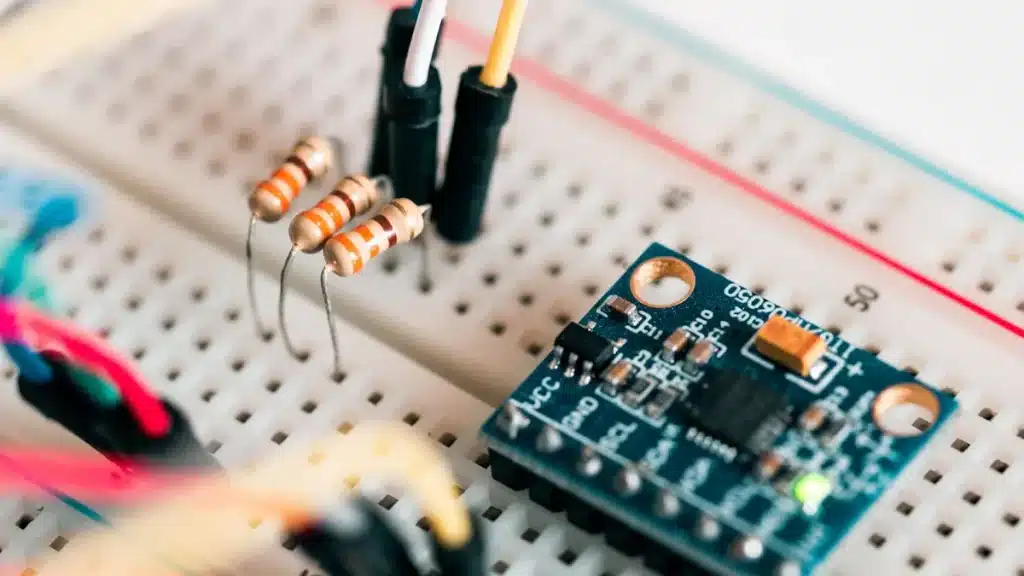
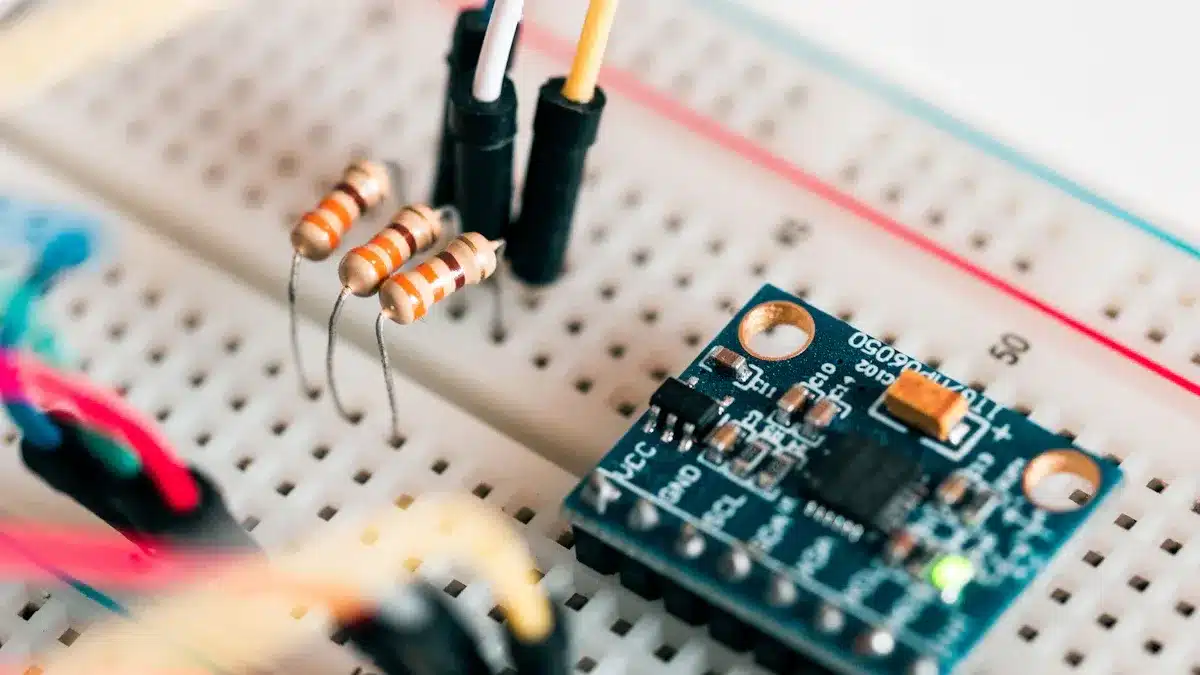
A variable resistor is an electronic part. It lets people change its electrical resistance. These parts are very important in electronics. They control current, voltage, and signal levels. This happens in many circuits. Changing resistance changes how a circuit works. This has many real-world uses. Knowing about different variable resistors is key. Their variable resistor symbol is also important for circuit design. The global variable resistor market was worth about USD 1.5 billion in 2023. This market has devices like the potentiometer.
Key Takeaways
Variable resistors let you change electrical resistance in a circuit. This helps control current. It also helps control voltage.
Potentiometers are common variable resistors. They divide voltage. They are used for volume control. This is in audio devices.
Rheostats are another type. They control current. This is in a circuit. An example is motor speed control.
Different variable resistors exist. They are for specific jobs. LDRs are for light. FSRs are for force. Thermistors are for temperature.
Each variable resistor has a special symbol. This is in circuit diagrams. An arrow is on the symbol. It means resistance can change.
Variable Resistor Basics

What is a Variable Resistor
A variable resistor is an electronic part. It lets people change its electrical resistance. This change happens within a certain range. Engineers use these parts. They control current, voltage, and signal levels. This happens in circuits. They are key for many electronic designs. For example, a radio’s volume knob uses one. You change resistance. You move a part called a wiper. It moves along a resistive material. This changes how much resistive material is in the circuit. This affects current and voltage. This follows Ohm’s Law (V = IR). Changing the variable resistor changes the path’s length. This changes the resistance. It affects the current or voltage.
Understanding the Variable Resistor Symbol
Every electronic part has a symbol. This symbol helps engineers. They draw and understand circuits. The general variable resistor symbol shows a standard resistor. An arrow passes through it. This arrow means the resistance can change. Sometimes, the arrow points to the resistor. It comes from above. This symbol tells you something. The part is a variable resistor. Its resistance value is not fixed. Knowing this variable resistor symbol is important. It helps read circuit diagrams.
Exploring Types of Variable Resistors
Many types of variable resistors exist. Each type has a different use. They all change resistance. This happens based on some input. For example, a potentiometer changes resistance. You turn a knob. Other types react to light. Some react to force or temperature. Understanding these different types helps. It helps choose the right part for a project.
Type of Variable Resistor | Operational Mechanism (Technical Aspects) |
|---|---|
Potentiometer | Uses a wiper and a resistive element. It is often made of special materials. This is for adjustment. |
Rheostat | Has two terminals. It mainly controls current. |
Photoresistor | Works based on photoconductivity. Its resistance changes with light. |
Wirewound Resistor | Uses a resistive wire winding. This is for precise operation. |
Thermistor | Its resistance changes with temperature. It is used for temperature control. |
Varistor | Works by switching based on voltage. It protects against power surges. |
Potentiometers: A Useful Variable Resistor
Potentiometers are a common variable resistor. They precisely control electric signals. Engineers use them in many devices. A potentiometer changes resistance. A mechanical movement does this.
Rotary and Slider Potentiometers
Potentiometers come in different shapes. Rotary and slider types are most common. A rotary potentiometer changes its resistive value. It uses a turning motion. A knob or dial turns a shaft. This makes a wiper move. It sweeps around a curved resistive part. Slider potentiometers change resistance differently. They use a straight motion. The slider’s position directly relates to the output resistance.
Here is a comparison of their features:
Feature | Rotary Potentiometer | Slider Potentiometer |
|---|---|---|
Resistive Element | Arc-shaped (track) | Straight track |
Wiper Movement | Rotates along the arc-shaped track | Slides linearly along the straight track |
Types | Arc-segment, Multi-turn | N/A |
Potentiometer types also include linear and logarithmic. Linear potentiometers change resistance evenly. Logarithmic potentiometers change resistance in steps. This is good for audio. Materials also differ. Film-type potentiometers use carbon or plastic. Wire-wound potentiometers use resistive wire.
Potentiometer as Variable Resistor Function
A potentiometer is an adjustable resistor. It has a wiper. The wiper moves across a resistive strip. This movement changes the resistance. It affects the current to a circuit. This design lets it divide voltage.
A voltage divider’s output depends on its two resistive parts. Changing both parts by the same amount does not change the output voltage. The load on the voltage source depends on the potentiometer’s total resistance. For example, a 10 kΩ potentiometer and a 10 Ω potentiometer both get 12 V. Both give 0 to 12 V output. This is at the same wiper spots. But the 10 kΩ pot uses 1.2 mA. It uses 14.4 mW of power. The 10 Ω pot uses 1.2 A. It uses 14.4 W of power.
The potentiometer’s output impedance is complex. It is the two resistances combined. This depends on the wiper’s spot. At the ends, output impedance is 0. In the middle, it is 1/4 of the total potentiometer value. For example, a 10 kΩ pot set to the middle (6 V output) has 2.5 kΩ output impedance. Drawing current from the output makes voltage drop. For example, 1 mA from the 6 V output of a 10 kΩ pot. This causes a 2.5 V drop. Only 3.5 V remains. Output voltage from different potentiometers is the same. This is true at the same wiper spot. But only if no current is drawn. This means it connects to infinite impedance.
To use a potentiometer as variable resistor and voltage divider:
The middle contact (wiper) connects to output voltage.
The other contact can be grounded.
Adjusting the handle moves the contact. It slides along the resistive part.
This makes an output voltage. This output voltage relates to input voltage. It also relates to the wiper’s angle and travel.
Potentiometer Schematic Symbols
Potentiometer schematic symbols differ by standard. The IEC symbol shows a rectangle. An arrow points to the middle. The ANSI symbol uses a zig-zag resistor. It has a diagonal arrow. Both standards show three terminals. These are two end terminals. One is a wiper terminal. This makes them three-leg variable resistors. The potentiometer symbol can also have numbers. For example, ‘1’ and ‘3’ are for ends. ‘2’ is for the wiper. For rotary potentiometers, a circle shows turning. Linear potentiometers show a straight line. These shapes do not change how they work. They make things clear.
Linear and logarithmic potentiometers use the same symbol. The difference is usually written. Engineers write “log” near the symbol. This is for a logarithmic taper. They do not use different symbols. This general variable resistor symbol helps circuit designers.
Common Potentiometer Applications
Potentiometers are used in many electronic systems. They are key for control and sensing.
In audio equipment, potentiometers are very common:
Tone and EQ shaping
Channel balance and blend circuits
Filter or modulation control in pedals, mixers, and amplifiers
They balance left/right audio channels. They use dual-gang potentiometers. They control volume in audio amplifiers. They fix problems with digital encoders. They give better accuracy. They make users happier. Engineers suggest them for audio and volume control. This includes headsets, radios, and amplifiers. They often use a logarithmic taper. This is for natural volume changes.
Potentiometers are also used as position sensors. In sensor systems:
Linear Position Sensors: Linear potentiometers are used in robots. They give exact feedback on position. This is vital for controlling machines. It is also vital for robot arms.
User Interfaces: Potentiometers are in user interfaces. They adjust settings. These include speed, brightness, or resistance. Engineers find them in thermostats. They are also in dimmers and instrument panels.
In touch-screen devices, a two-dimensional potentiometer finds x and y spots. This uses a thin glass top layer. It has a clear conductive coating. It also has a bottom layer. This has a clear resistive coating. When a finger touches the glass, it makes contact. Voltages are put on the resistive layer’s edges. This measures one coordinate from the top layer. By changing voltage to the other two edges, the second coordinate is found. This gives frequent position updates. An analog-to-digital converter does this. Potentiometers also measure position on gaming joysticks.
Rheostats: Controlling Current
Defining Rheostats and Their Use
Rheostats are important circuit parts. They control how much current flows. They do this by changing resistance. A rheostat adjusts circuit resistance. It moves a sliding part. This gives exact control. This is key in circuit design. It is also key where specific resistance is needed. Rheostats also divide voltage. They limit current. They clean up signals. They fix temperature changes.
Rheostats are vital parts. They control current by changing resistance. Their ability to adjust resistance makes them useful. They are in many devices. These include lights. They control motor speed. They are in audio systems. They are also in tools. Rheostats are like potentiometers. Both are variable resistors. But rheostats control current. Potentiometers usually divide voltage.
Rheostats are used in factories. They control DC motor speed. This is true for brush motors. They change the current to these motors. They also work in heaters. They work in temperature control. Examples are electric heaters. Soldering irons use them. Lab heating plates use them. They control power and heat. Older welders use rheostats. Furnaces use them. Heavy industrial systems use them. They control power flow. These often use wire-wound types. This is because wire-wound rheostats handle high power.
Factory motor control
Heater control systems
Welders and factory controls (older machines, furnaces, heavy systems)
Circuit testing and load simulation
Rheostat Schematic Symbols
Rheostats have special symbols. These are in circuit diagrams. There are two common rheostat symbols. The American symbol has three terminals. It has zigzag lines. The international symbol has a box. It has three terminals. A rheostat has three terminals: A, B, and C. Engineers can use it. They connect A and B. They can also connect B and C. Some say a rheostat has two terminals. This is different from resistance that changes.
Rheostats vs Potentiometers
Rheostats and potentiometers both change resistance. But they have different main uses. They have different designs. Rheostats control current flow. Potentiometers divide voltage. They adjust output voltage.
Feature | Potentiometer | Rheostat |
|---|---|---|
Number of Terminals | Three | Two |
Rheostats are made for more power. They often use wire coils. Potentiometers often use carbon film. This makes it harder for potentiometers to cool.
Feature/Function | Rheostat | Potentiometer |
|---|---|---|
Primary Function | Controls current by changing resistance | Divides voltage to adjust output |
Number of Terminals | Two | Three |
Power Applications | Higher power uses | Lower power uses, exact voltage control |
Typical Applications | Motor speed, light dimming, heater temperature | Audio volume, signal reception, sensor setup |
Power Dissipation | Made for higher power (e.g., >50 watts) | Made for lower power (e.g., <1 watt) |
This part talks about other important variable resistor types. They have special features. They also have specific uses. Their resistance changes based on outside things.
Light Dependent Resistors (LDRs)
Light Dependent Resistors (LDRs) are also called photoresistors. Their resistance changes with light. An LDR’s resistance goes down in bright light. It goes up in darkness. This happens because of photoconductivity. Light energy makes electrons active. This creates more free charge carriers. It leads to lower resistance.
LDRs have many uses. They turn on street lights at night. They turn them off in the morning. This saves power. They change inside light levels. This makes light better. It also saves energy. LDRs are in security systems. They sense light changes. This sets off alarms.
Force Sensing Resistors (FSRs)
Force Sensing Resistors (FSRs) change resistance with pressure. They use a special plastic. This plastic changes resistance when pushed. The sensing film has parts that conduct. It also has parts that do not conduct. Pushing makes these parts touch wires. This changes the film’s resistance. Without force, the sensor has very high resistance. When force is put on it, conducting parts move closer. This lowers electrical resistance.
FSRs are useful when people use computers. They are in robots. They feel human touch. Engineers put FSRs into wearable devices. These devices guess how a human arm is placed. This helps robots avoid hitting things.
Thermistors and Their Function
Thermistors are resistors that feel temperature. Their resistance changes with temperature. Negative Temperature Coefficient (NTC) thermistors are common. Their resistance goes down as temperature goes up. Heat gives more energy to electrons. This lets them move to the conduction band. This makes more charge carriers. It lowers electrical resistance.
Thermistors are in many products. They check engine temperature in cars. They control air conditioning. They are in medical tools. These include patient monitors. They also include surgery tools. Thermistors are in heating and cooling systems. They sense room temperature. They control water heaters.
Other Variable Resistor Types
Varistors are another kind of variable resistor. Their resistance changes with voltage. They act like voltage-dependent resistors (VDRs). With normal voltage, they have high resistance. When voltage gets too high, resistance drops fast. This stops voltage spikes. Varistors protect quickly. They are in surge protectors. They protect power supplies.
Digital potentiometers are also variable resistor types. They offer exact control. Computers or software can adjust them. They do not wear out mechanically. This makes them more reliable. They are in audio devices for volume. They also adjust screen brightness.
This article looked at different variable resistors. These include potentiometers and rheostats. It also included special sensors. Each one has a special job in electronics. Knowing the right symbol for each part is key. This helps design and fix circuits. You should try using these parts. Put them in your own projects. Variable resistors are very important in electronics today. They give exact control. They can also change easily.
FAQ
What is the main difference between a potentiometer and a rheostat?
A potentiometer splits voltage. It has three ends. A rheostat handles current. It usually has two ends. Engineers use potentiometers for signals. They use rheostats for power.
How does a variable resistor control current or voltage?
A variable resistor changes its inside resistance. This affects current flow. It also changes voltage drop. This follows Ohm’s Law. Changing resistance directly impacts how a circuit works.
Can engineers use any variable resistor for any purpose?
No, engineers pick specific variable resistors. They pick them for different tasks. Potentiometers are good for splitting voltage. Rheostats handle bigger currents. Special resistors like LDRs react to light. Each type has special uses.
What does the arrow on a variable resistor symbol mean?
The arrow on a variable resistor symbol means it can be changed. It shows the resistance is not set. Engineers can adjust it. This arrow helps find parts that can change in circuit drawings. 💡
Why are variable resistors important in electronics?
Variable resistors are key for control. They let people finely tune signals. This includes sound, light, and motor speed. They make circuits act in different ways. They are basic parts in many electronics.
See Also
Understanding Essential Acronyms and Terminology in PCB and PCBA Manufacturing
Streamlining Rapid PCBA Assembly for Your Electronics Projects with Ease
Discovering the Essential Features of the PCBA Santa Cruz Lamp
Exploring Key Distinctions Between Active and Passive Electronic Components
Unveiling Functional and Structural Differences: PCBA Versus PCB Explained